InfoGaia
How to run a fair 14-day trial of a joint supplement
Most debates about supplements end in noise because people test them poorly. A fair trial is short, disciplined, and designed to produce clear, usable data — not emotional stories. Below is a simple protocol you can run in two weeks that helps you answer one practical question: Is this supplement producing consistent, repeatable improvement in a marker that matters to you?
The logic of a short, disciplined trial
A 14-day window is long enough to detect early, repeatable signals (sensory changes, morning stiffness, functional ease) and short enough to avoid sunk-cost bias. The goal is clarity, not dramatic transformation: you’re running a small experiment that produces one binary outcome for your next decision (continue, tweak, or stop).
Choose one clear marker (the single-source metric)
Pick one simple, observable measure you can repeat reliably each day. Examples:
Sit-to-stand test: time how many slow, controlled sit-to-stands you can do in 60 seconds.
Morning stiffness rating: how long (minutes) before you feel “normal” after getting out of bed.
Functional task: can you climb one flight of stairs without stopping? (yes/no + perceived effort 0–10)
Write it down on Day 0. This single marker is your experiment’s anchor.
Baseline: gather Day 0 data (don’t guess)
Before you take the first dose:
Record your chosen marker (one measurement).
Note the context: sleep duration, recent workouts, medications, recent travel, footwear.
Take a quick photo or video if the marker is movement-based (optional, helpful).
Rate pain/stiffness on a simple 0–10 scale at a consistent time (e.g., first thing in the morning).
These baseline notes reduce confusion later.
The daily routine (simple, repeatable)
Keep the routine lean and identical each day:
Take the supplement exactly as directed (same time, same dose).
Perform the same 5–10 minute movement habit after taking the supplement (for example: gentle joint circles, two targeted mobility drills, one integration movement).
Avoid introducing new treatments (new mattress, new shoes, new meds) during the 14 days.
Record the single marker every morning (or at a consistent time). Keep each entry brief and consistent.
The combination of dose + tiny movement is deliberate: it gives the supplement a fair chance while producing an opportunity window to practice movement.
How to record and visualize results (quick method)
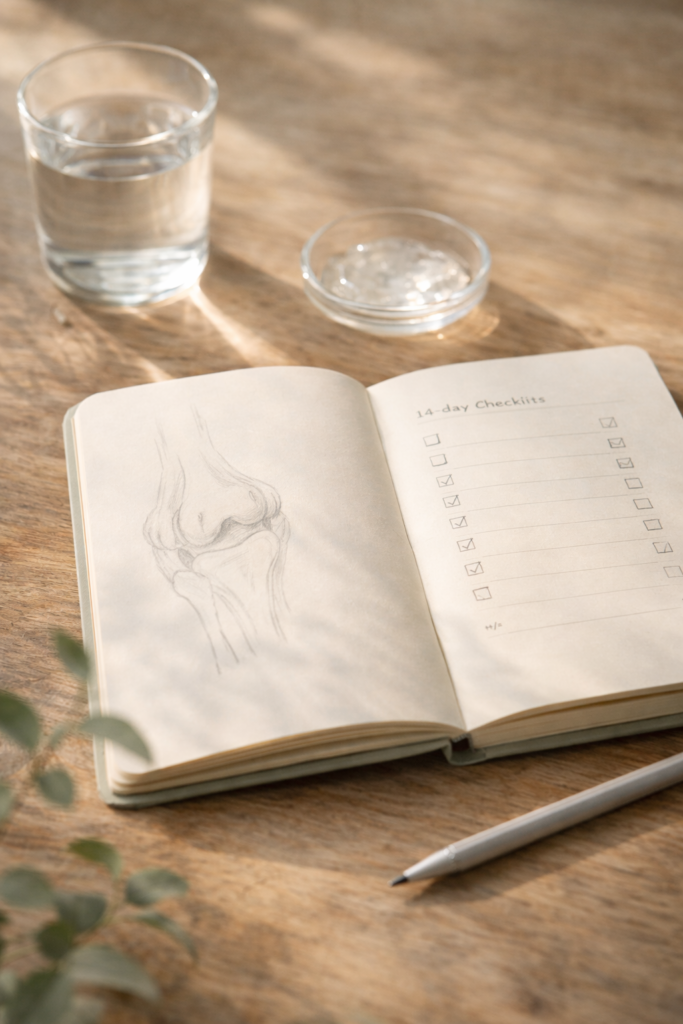
Use a simple table or a daily note app. Each day log:
Date
Marker value (number, time, or yes/no)
Pain/stiffness 0–10
One short note (sleep, unusual exertion, digestive issue)
At Day 7 and Day 14, compare the numbers. If you prefer visuals, plot the marker on a simple line: if the line trends consistently in the desired direction (not a one-off blip), that’s a positive signal.
Decision rules (avoid wishful thinking)
Use pre-written criteria so you don’t retro-rationalize:
Continue if you see a clear, repeatable improvement in the marker on at least 10/14 days or a marked improvement at Day 14 compared with Day 0.
Modify (adjust dose or pairing routine) if you see intermittent improvements but also large variability tied to other factors (sleep loss, heavy exercise).
Stop & redirect if there is no consistent trend, or if side effects appear, or if function worsens.
A rule-based decision removes emotion from the test.
Common pitfalls and how to avoid them
Changing too many things at once. Keep the trial isolated to the supplement + short movement habit.
Using vague outcomes. “I feel better” is not enough; use an observable marker.
Letting placebo and hope bias win. That’s why a short, repeatable marker matters.
Ignoring safety signals. Nausea, notable GI upset, or changes in bleeding require pausing and consulting a clinician.
How to interpret small, meaningful wins
Modest improvements are valuable. A reduction of 1–2 points on a 0–10 scale, fewer episodes of morning stiffness, or reliably better performance in a chosen task are all meaningful if they repeat. Think in terms of usability: does this supplement give you more moments of ease that let you practice movement or maintain daily function?
When a trial suggests a supplement is “helpful” — what next?
If you get a positive result:
Continue for another 2–4 weeks and monitor sustainability.
Introduce one improvement (e.g., slightly more challenging mobility) and observe transfer.
Consider whether the cost and subscription terms fit long-term use.
If not helpful, consider reallocating energy to movement, ergonomics, or professional consultation.
Tracking beyond 14 days (optional follow-up plan)
If you choose to continue, switch from daily logging to a weekly summary once the pattern stabilizes. Track one or two secondary markers (sleep quality, perceived exertion) but keep the original primary marker as the decision anchor.
Cross-reading
If you’d like to explore how gentle, structured movement can support joint and back comfort in a sustainable way, read the core guide here:
→ How intentional movement supports joint and back health
An inspiring next step...
Ready to run a clear 14-day trial of a lubrication-focused formula?
Affiliate disclosure: InfoGaia may earn a commission if you purchase via this link. Our editorial judgment is independent — we recommend trials, not guarantees.
Final Thoughts
A checklist is a small, honest ritual — a way to turn curiosity into learning. Over fourteen days you are not chasing miracles; you are gathering evidence, listening closely to small shifts, and honoring the simple fact that bodies respond to attention. Treat each ticked box as a gentle conversation with your joints: some days yield clear answers, some days only a whisper, and both are useful.
There is a quiet kind of courage in experimenting carefully. When you measure with kindness and repeat with patience, small improvements become invitations to more motion, not proof of inevitability. Let the checklist be your compass — not a verdict — and let curiosity, not urgency, steer the next step.
If the pattern you record points toward more ease, use that gift to practice the movement that matters. If it doesn’t, you’ve still won: data that frees you from guesswork and points you toward a wiser choice. Either way, the act of testing calmly is itself a stride toward lasting comfort.
— Gaia Oliveira, Wellness Editor
InfoGaia follows an editorial wellness model focused on education and research synthesis. This article is intended for educational purposes only and does not replace professional medical advice. Individual responses to movement, nutrition, or supplementation may vary, especially for individuals with pre-existing conditions. If symptoms are persistent, sudden, or severe, consult a qualified healthcare professional.
Some links within this article are affiliate links. If you choose to purchase through these links, InfoGaia may earn a small commission at no additional cost to you. This helps support our editorial work and the continued creation of independent wellness content.

InfoGaia
Carefully edited reflections on wellness, nature, and how living systems actually work.
Connect & Legal
Short, thoughtful notes. No noise.
© InfoGaia · 2026