InfoGaia
Knee pain from weak glutes: how hip weakness overloads your knees
A creaky knee often tells a story that begins somewhere else — like a river that erodes the riverbank downstream. What if your knees are asking for better support from above rather than repair at the joint itself? How might a few focused, daily steps change the load they carry?
Why this matters
Knee pain after 40 is often a system problem, not just a local fault.
When glutes and hip muscles are weak, the knee becomes the default shock absorber. Over months and years this extra load shows up as ache, stiffness, and avoidance of movement. Strengthening the hips redistributes force and can make daily steps feel steadier again.
Why should we care about the hips when the pain is in the knee?
How the hips and glutes affect the knee
Weak hips change the angle and tracking of the thigh bone, which changes force on the knee.
Glute medius controls side-to-side stability during walking and single-leg stance.
Glute maximus provides backward drive and supports the knee when rising from a chair.
When these muscles underperform, the quadriceps and inner knee structures pick up the slack.
Quick mechanism (plain)
Hip weakness → pelvic drop on the opposite side.
Increased inward angle (valgus) at the knee.
Higher compressive and shear forces across the knee joint.
Is it possible that a small muscle imbalance is quietly shaping your daily pain?
Simple movement checks you can do now
These micro-tests help you feel where the body is compensating — no equipment needed.
1. Single-leg balance (30 seconds)
Stand near a wall. Lift one foot slightly. Can you balance for 30 seconds without your hip dropping?
If your hip collapses, the glute medius may be underactive.
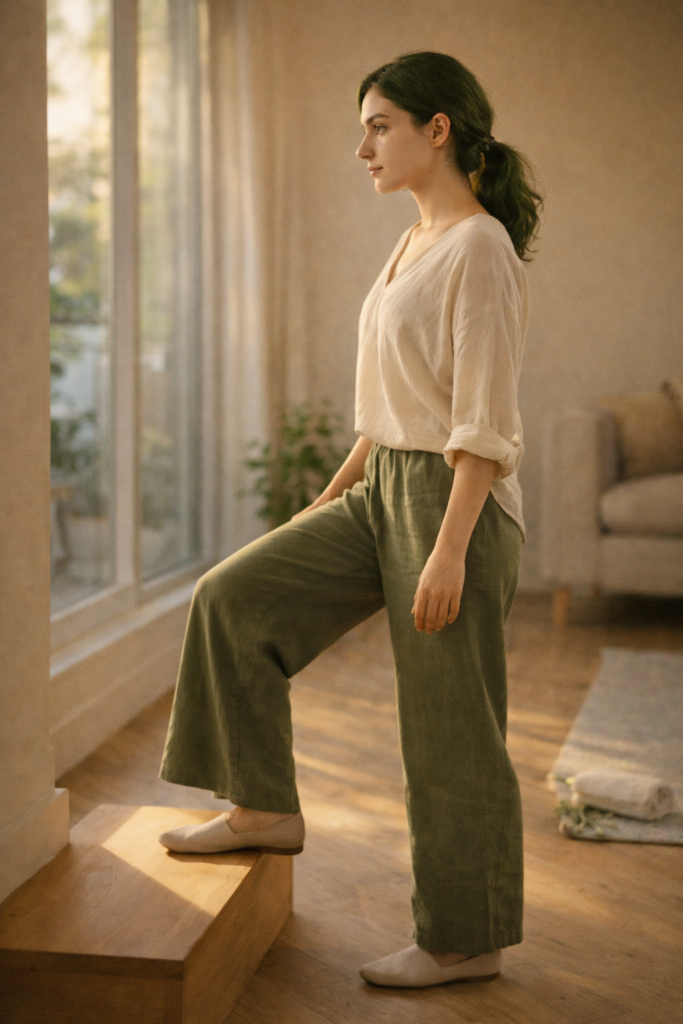
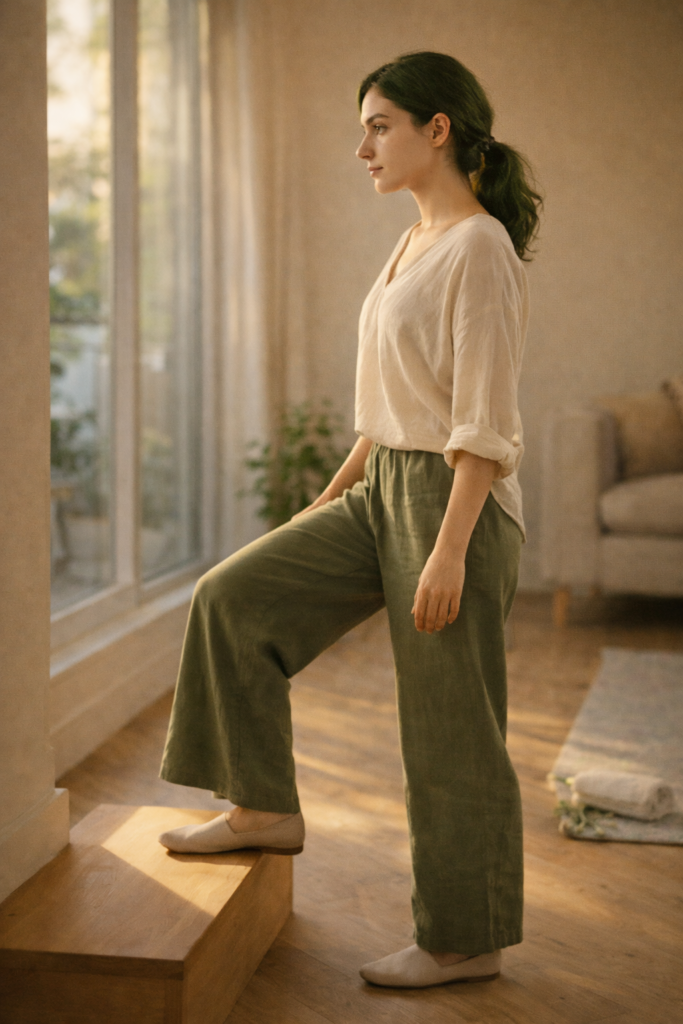
2. Step-up test
Step up onto a low stair. Does your knee cave inward or does your body stay aligned?
Knee-caving suggests lateral hip weakness.
3. Seated bridge (5 reps slow)
Lie on your back, knees bent. Lift hips slowly and feel the glutes engage.
Is the movement driven by your lower back instead of your hips?
Would you notice a difference after trying these checks for a week?
A simple 2-week micro-plan to support your hips
No heavy gym time — just short, consistent practices that promote stability.
Daily (5–8 minutes total)
Warm-up: March in place — 60 seconds.
Glute activation: Clamshells — 2 sets of 10 each side (slow).
Bridge holds: 3 × 10-second holds with slow descent.
Standing hip abductions: 2 sets of 8 each side.
Every other day
Single-leg balance progression: 3 × 30 seconds each side (use support as needed).
Controlled step-ups: 3 × 8 each leg (low step).
Weekly
One longer walk (20–30 minutes) at comfortable pace; focus on steady posture and glute engagement.
How might a five-minute daily ritual change your confidence to move?
Micro-tips for success
Keep reps slow and intentional — quality beats quantity.
Breathe steadily; avoid holding tension in the neck or jaw.
If an exercise increases sharp pain, stop and try a gentler alternative (see ethical note).
Cross-reading & context
If this idea of “supporting the knee from above” feels new, you may also enjoy our upcoming deep-dive on Hyperbolic Stretching, where we explore how gentle, controlled lengthening of the hips can reduce unnecessary tension around the knees and lower body. It’s a complementary lens on the same principle: when movement is shared, joints suffer less.
A gentle next step
If this perspective resonates, you may want a guided, step-by-step routine that focuses on hip stability and joint-friendly progression.
This post contains affiliate links; InfoGaia may earn a commission if you purchase through these links.
Final thoughts
Knees rarely ask to be “fixed.” More often, they ask to be supported.
When hips and glutes regain their role, the knee no longer needs to absorb every step, every rise from a chair, every moment of imbalance. Progress here isn’t loud or dramatic — it’s quiet, steady, and deeply reassuring. And sometimes, that’s exactly how real change begins.
— Gaia Oliveira, Wellness Editor
InfoGaia follows an editorial wellness model focused on education and research synthesis. This article is intended for educational purposes only and does not replace professional medical advice. Individual responses to movement, nutrition, or supplementation may vary, especially for individuals with pre-existing conditions. If symptoms are persistent, sudden, or severe, consult a qualified healthcare professional.
Some links within this article are affiliate links. If you choose to purchase through these links, InfoGaia may earn a small commission at no additional cost to you. This helps support our editorial work and the continued creation of independent wellness content.

InfoGaia
Carefully edited reflections on wellness, nature, and how living systems actually work.
Connect & Legal
Short, thoughtful notes. No noise.
© InfoGaia · 2026